Awaitable for submitting transfers. More...
#include <transfer_awaitable.hpp>
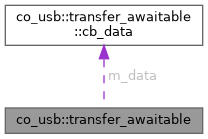
Collaboration diagram for co_usb::transfer_awaitable:
Classes | |
| struct | cb_data |
Public Member Functions | |
| transfer_awaitable (libusb_transfer *tfer) noexcept | |
| bool | await_ready () noexcept |
| std::coroutine_handle | await_suspend (std::coroutine_handle<> h, boost::capy::io_env const *env) |
| suspends and submits the transfer | |
| boost::capy::io_result< size_t > | await_resume () |
| returns the result of a tranfer as an std::error_code and size of transfer's buffer contents after the operation. | |
Public Attributes | |
| libusb_transfer * | transfer = nullptr |
| struct co_usb::transfer_awaitable::cb_data | m_data |
Detailed Description
Awaitable for submitting transfers.
- Note
- This class does NOT allocate at all
This is the lowest possible representation level of an asynchronous unit of libusb. It does not care for any of a transfer's properties and does not have direction- or transfer type-related bevahioral differences.
You should use this awaitable for porting an existing codebase to co_usb or when you need ultimate control.
- Note
- user_data and callback fields of a transfer object ARE OVERRIDDEN on await_suspend with internal coroutine machinery, to access data from a completed transfer consider inspecting the transfer object after the completion of the awaitable.
Constructor & Destructor Documentation
◆ transfer_awaitable()
|
noexcept |
Member Function Documentation
◆ await_ready()
|
noexcept |
- Returns
- always false, a transfer cannot be completed without roundtrip.
◆ await_resume()
| boost::capy::io_result< size_t > co_usb::transfer_awaitable::await_resume | ( | ) |
returns the result of a tranfer as an std::error_code and size of transfer's buffer contents after the operation.
◆ await_suspend()
| std::coroutine_handle co_usb::transfer_awaitable::await_suspend | ( | std::coroutine_handle<> | h, |
| boost::capy::io_env const * | env | ||
| ) |
suspends and submits the transfer
- Parameters
-
h std::coroutine_handle to the awaiting coroutine env boost::capy::io_env* as per boost::capy::IoAwaitable concept
- Returns
- std::noop_coroutine on success
-
hon submission error or on cancellation
Member Data Documentation
◆ m_data
| struct co_usb::transfer_awaitable::cb_data co_usb::transfer_awaitable::m_data |
◆ transfer
| libusb_transfer* co_usb::transfer_awaitable::transfer = nullptr |
The documentation for this struct was generated from the following files:
- /home/runner/work/co_usb/co_usb/include/co_usb/transfer/transfer_awaitable.hpp
- /home/runner/work/co_usb/co_usb/src/transfer/transfer_awaitable.cpp